Grantmakers for Girls of Color

Abundantly investing in Girls of Color

  • About
    • Mission & Values
    • History
    • Staff & Board
  • Our Work
    • Funds
    • Love Is Healing
    • Black Girl Freedom Fund
    • Holding a Sister Initiative
    • New Songs Rising Initiative
    • Catalytic Futures Fund
    • Special Projects
  • Our Impact
    • Grantees
    • Press & Op-Eds
    • Research & Reports
    • News & Updates
  • Engage & Connect
    • Events & Convenings
    • Community Funding Opportunities
    • Careers at G4GC
    • Contact
  • Give
  • About
    • Mission & Values
    • History
    • Staff & Board
  • Our Work
    • Funds
    • Love Is Healing
    • Black Girl Freedom Fund
    • Holding a Sister Initiative
    • New Songs Rising Initiative
    • Catalytic Futures Fund
    • Special Projects
  • Our Impact
    • Grantees
    • Press & Op-Eds
    • Research & Reports
    • News & Updates
  • Engage & Connect
    • Events & Convenings
    • Community Funding Opportunities
    • Careers at G4GC
    • Contact
  • Give

A Conversation with Monique Couvson, President and CEO of G4GC

Published February 2, 2026

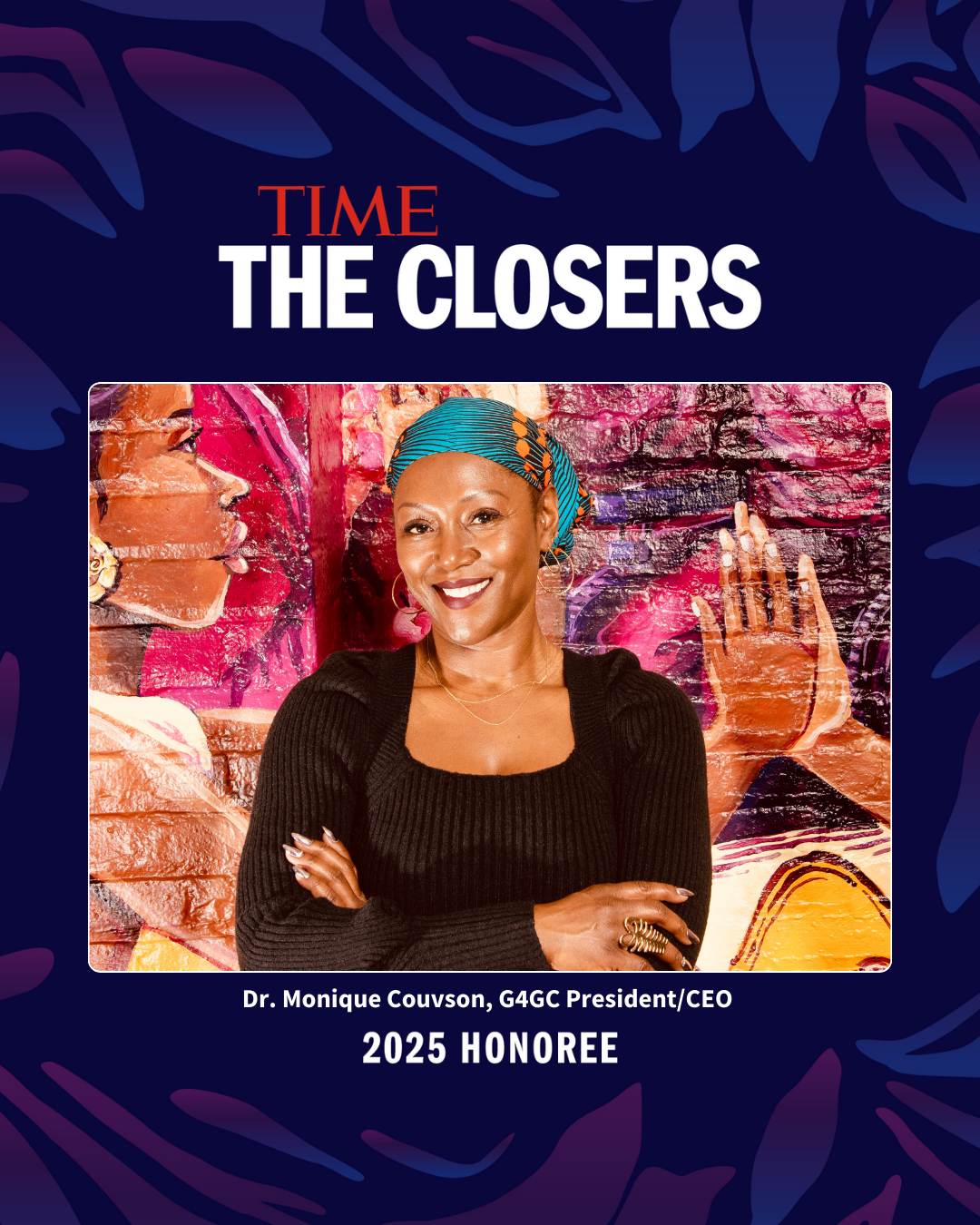
Dr. Monique Couvson is the president and CEO of G4GC (formerly Grantmakers for Girls of Color), a philanthropic intermediary that supports organizations and movements that center the wellbeing of girls and gender-expansive youth of color. She also cofounded the National Black Women’s Justice Institute, which seeks to dismantle pathways to criminalization and confinement and increase safety and opportunities for Black women and girls impacted by the criminal and juvenile legal systems.

Couvson’s more than three decades in the fields of education, civil rights, juvenile and social justice include roles at Mount St. Mary’s College of California, the University of San Francisco, and California State University, Sacramento. She was also an executive producer and co-writer of the documentary, “Pushout: The Criminalization of Black Girls in Schools,” which was based on two of Couvson’s books, “Pushout: The Criminalization of Black Girls in Schools,” and “Sing a Rhythm, Dance A Blues: Education for the Liberation of Black and Brown Girls.” She has written several other books, including “Black Stats: African Americans by the Numbers in the Twenty-First Century” and the graphic novel “Charisma’s Turn: A Story of Girls and Their Gifts.”

We recently connected with Couvson to discuss her latest book, “Girls, Unlimited: How to Invest in Our Daughters with More Than Money,” which looks at how and why everyone from philanthropists to parents and policymakers should invest in girls. Her book looks at several areas of investment, including increasing knowledge and awareness, dismantling the barriers to girls’ success, protecting girls from gender-based violence and supporting education and mentorship.

Read the full interview by Martha Ramirez on Inside Philanthropy.
This conversation has been edited for clarity and length.

You mentioned in your book that part of the reason why you wrote “Girls, Unlimited” was a high school student asking when you would write your own story. Can you elaborate a little on how you came to write the book and why you chose to interweave your own story into your discussion of how to support girls of color? I found it a very effective and very striking approach.

As I started to reflect on what brings me to this work — and especially the question from that student — I realized that my personal story is not as divorced from, and is actually intrinsically linked to, what drives me to lead my work professionally in this realm. This was an opportunity for me to locate myself in the work and do some reflection on the things that I have learned along the way, but also on the things that have taught me about how to show up in this moment for girls, and how we structure systems and create platforms for girls to be their full selves in this work. 

I’m actually a very private person. It was a challenge to write as much as I did about my own personal story because I’ve survived a lot of systems and a lot of things. But I think it was an important part of helping people understand that women in positions of leadership don’t just appear, that there are specific things that happen in their lives, specific people who show up in their lives, to make that trajectory possible, to make their leadership plain, to create spaces for girls to practice leadership so that when they do become women who are interested in leadership, they have some experience in that domain. 

For me, it was an important part of bringing people in closer so that they can hopefully do the same thing, read the book and begin to locate themselves in the work.

As a journalist, when I write about women and girls, I’ll often draw from reports that present statistics. And they’re always helpful, of course, but it’s very different to read about someone’s experiences. It puts things in a better context. 

I would hope so. We know that less than 2% of philanthropic giving goes to women in this country. And we know that giving to girls of color is nearly nonexistent. Less than half a percent of philanthropic giving goes to women and girls of color around the globe. And so when we look at those numbers, we’ll say, “oh, this is really low. This is abysmal.” 

But what I wanted to share in “Girls, Unlimited” is what it feels like to be in conversation with these girls, to recognize their brilliance and recognize that when we are underinvesting in that brilliance, we’re doing ourselves a grave disservice. I say in the book, a lot of times, people will see girls and think, oh girls are cute, and so we get cute money. It’s important to recognize girls are powerful, to recognize girls as transformative, to recognize girls are critical and essential people in creating the kinds of worlds we want for ourselves and our descendants. 

And so the intention around the storytelling in “Girls, Unlimited” is sharing my own experiences as a girl but also thinking about the things that I learned as a mother and things that I have learned as an advocate for girls. If I had to boil it down, I do want people to see the statistics because I think the statistics are critical for us to understand the gravity of the situation, but I also want people to hear the stories of young people who are doing incredible work and who are taking deficits in their lives and transforming those into positive outcomes and transforming communities as a result. 

As you noted in your book, money matters, but how can funders change their grantmaking to better support girls of color and go beyond just writing a check?

I love that question because that was the whole point of the book. Of course, money matters. Of course it does. But I wanted to start with all the things that we can do that don’t necessarily involve writing a check. That doesn’t mean that they’re not related.

Investing in girls’ knowing, and understanding that this critical capacity for girls to be able to analyze the lives that they’re living and the society that they’re living in is essential to recognizing that there are parts of intervention that philanthropy can engage in. It is critical to understand that if we prioritize protecting girls’ bodies and investing in their education and mentorship and thinking about exposing them to policies that will ultimately impact their lives, that if we understand that these are nonfinancial investments that we can make, then we align our financial investments to support the practices and capacity for organizations to do those things. 

I also think it’s important for people to recognize that philanthropy comes in many different ways. People give in different ways, and the biggest thing we have to give is our time. And so it is important for philanthropy to recognize a much more expansive way of giving, such that it is also about relationship-building and trust-building.

We’ve had these kinds of conversations a bit in philanthropy around trust-based interventions or other strategies to rely more on the expertise of those who are living the experience. But what’s critical for me is for us to build relationships with people that allow us to align our actions with our funding. If we fund girls’ programs, then we should also be in relationship with them.

Yes, we have young people who are part of our decision-making structures, but we are also in routine conversation with the organizational leaders who are working directly with girls every day, and we are in direct conversation with young people and young people who identify as girls all the time. They are part of critical analyses. They are part of our strategic planning. Their comments have been part of how we approach fundraising to educate the field about the importance of working with girls. They are embedded in so much of what we do because the relationship is key. So the invitation from “Girls, Unlimited” is to grow philanthropic capacity to be more proximate to the issues affecting girls and to girls themselves.

And on the funding side, philanthropy has long been aware of and has acknowledged that girls and girls of color are vastly underfunded, and yet we’ve seen little progress. What would you say to funders to encourage them to open their pocketbooks?

We celebrated that funding to women and girls reached 2%. And it’s not that girls are not benefiting from some of the other investments that philanthropy is making, but we’re not being intentional about locating girls in those spaces, which continues to perpetuate the disparities that we see on the outcomes. 

So I would say: Understand that when we are developing priorities around issues that every issue impacts girls. If your priority is around policymaking and political mobilization, locate girls in that conversation. If your funding is primarily about health and healthcare access, locate girls in that conversation. If your funding is around education, don’t just think about institutions; think about young people who are experiencing those institutions. When we name them, we consider them a priority. 

That’s a lesson I learned just doing my research work, and developing my scholarship around pushout and education. It’s when we have these kinds of conversations and we begin to locate girls in the conversation, that’s when we can hold ourselves accountable to building out priorities that include girls in grantmaking. 

You wrote about the retrenchment in funding for racial justice and gender justice. How do we move forward from this moment where it seems like so many people and institutions are pulling back?

I think people are pulling back out of fear, and I also think people are pulling back out of ignorance. I believe it is our responsibility at this moment to continue to educate those who are responsible for setting priorities around giving to better understand the outcomes of the investments that they make. Investing in girls, investing in girls of color, investing in people of color, investing in women are not strategies to reduce giving to those who don’t identify with those communities. These are strategies to improve the conditions for all of us. When we say “justice for all,” we are not in a competition around our humanity. 

The retrenchment is something that is painful. When I write about it in the book, I’ve intentionally shared that some of the hardest conversations we had were with grantees who did not survive this retrenchment. And it was infuriating in some ways that people would want to take away a program that allows girls to dream about their futures. It’s unconscionable that we see these programs as anything other than opportunities to remedy centuries of bias. That’s all they are — opportunities for young people to dream, opportunities for young people to have access to opportunities that they have previously been left out of. It’s an intentional way to bring people in, not to exclude. 

My response to the retrenchment is that we have an opportunity in front of us to think about all that we have learned from the gender-conscious interventions that we have built over the past few years in response to the intentional exclusion of women and girls. We have learned so much from our time in that space that it’s time for us to then think about how we consider supporting the things that we know are working — whether or not we call it the things that we have called it in the past — that we have lessons that we have learned from this work and that we move forward. What is most critical in this moment is to protect the work, protect the things that we know to serve all children. 

If you talk to young children, they also believe in equity and justice. They also believe that everyone can win in this scenario. They’re not yet afraid of each other. And so when we talk to and engage with young people, we can reflect and mirror the values and priorities that they set for their lives, such that our grantmaking can support their visions into the future. 

My hope is that this retrenchment ends, that we are able to understand now and into the future that not only are these sound investments in the future, but that building ecosystems that engage every child is how we come to a philanthropic agenda that serves every community.

G4GC News Press News Book G4GC Girls Unlimited

Previous Post

Monique Couvson Wants Society to Better Understand Black Girls

Next Post

North Omaha event highlights women’s empowerment during Women’s History Month

Related posts

Press News

COVID-19 Webinar: How Philanthropy Can Respond- A Funder Webinar on April 28

G4GC News

Inside Philanthropy: How Philanthropy Can Follow the Lead of Girls of Color

G4GC News

Inside Philanthropy: Staffing Up and Moving Money, Grantmakers for Girls of Color Charts a New Course

Stay Connected

Go in depth with our quarterly newsletter

See how our work continues to impact our community throughout the year.

See more

Newsletter

Stay connected and invested. Join our G4GC mailing list to get updates on our progress and to see what great things are happening in our community.

    Are you a …?

    Donate

    donate

    Your donation drives real change for girls and gender-expansive youth across the U.S., Puerto Rico, Washington, D.C., and Guam—advancing justice, equity, and opportunity in their communities.

    Donate

    Footer

    G4GC logo with tagline

    About

    • Mission & Values
    • History
    • Staff & Board

    Our Work

    • Funds & Initiatives
    • Catalytic Futures Fund
    • Special Projects

    Our Impact

    • Grantees
    • Press & Op-Eds
    • Research & Reports
    • News & Updates

    Engage

    • Events & Convenings
    • Community Funding Opportunities
    • Careers at G4GC
    • Contact
    [email protected]

    instagram youtube linkedin facebook facebook

    All rights reserved. Copyright © 2026. Grantmakers For Girls of Color (G4GC) Terms of Use | Privacy Policy
    G4GC is a fiscally sponsored project of Rockefeller Philanthropy Advisors, a 501c3. The EIN number for RPA is 13-3615533